Saturday, 7 April 2012

Environment
Australian forests are mostly made up of evergreen species, particularly eucalyptus trees in the less arid regions, wattles replace them in drier regions and deserts as the most dominant species. Among well-known Australian fauna are the monotremes, including the kangaroo, koala, and wombat, and birds such as the emu and the kookaburra Australia is home to many dangerous animals including some of the most venomous snakes in the world. The dingo was introduced by Austronesian people who traded with Indigenous Australians around 3000 BCE


How did it gain its independence
Australia has gained complete independence from Britain. This was a long process, beginning with Federation, when the six states came together as one federated nation, under an Australian Prime Minister.
As a British Colony and later a British Dominion Australia gradually gained more and more autonomy. It did not achieve full independent Sovereignty until 3 March 1986, when the Australia Acts came into effect, terminating all British jurisdiction over Australia.
As a British Colony and later a British Dominion Australia gradually gained more and more autonomy. It did not achieve full independent Sovereignty until 3 March 1986, when the Australia Acts came into effect, terminating all British jurisdiction over Australia.
It's timeline
|
|
|
|
|
|
|
|
|
|
|
|
|
|
|
|
|
|
|
|
|
|
|
|
|
|
|
|
|
|
|
|
History of Australia
 aboriginal inhabitants, a hunting-gathering people generally referred to as Aboriginals and Torres Straits Islanders, arrived about 40,000 years ago. Although their technical culture remained static--depending on wood, bone, and stone tools and weapons--their spiritual and social life was highly complex. Most spoke several languages, and confederacies sometimes linked widely scattered tribal groups. Aboriginal population density ranged from 1 person per square mile along the coasts to 1 person per 35 square miles in the arid interior. When Capt. James Cook claimed Australia for Great Britain in 1770, the native population may have numbered 300,000 in as many as 500 tribes speaking many different languages. The aboriginal population currently numbers more than 410,000, representing about 2.2% of the population. Since the end of World War II, the government and the public have made efforts to be more responsive to aboriginal rights and needs.
Australia was uninhabited until stone-culture peoples arrived, perhaps by boat across the waters separating the island from the Indonesia archipelago about 40,000 years ago. Portuguese, Spanish, Dutch, and English explorers observed the island before 1770, when Captain Cook explored the east coast and claimed it for Great Britain
Meaning of Australia Flag
Symbolism and Meaning of Australia Flag
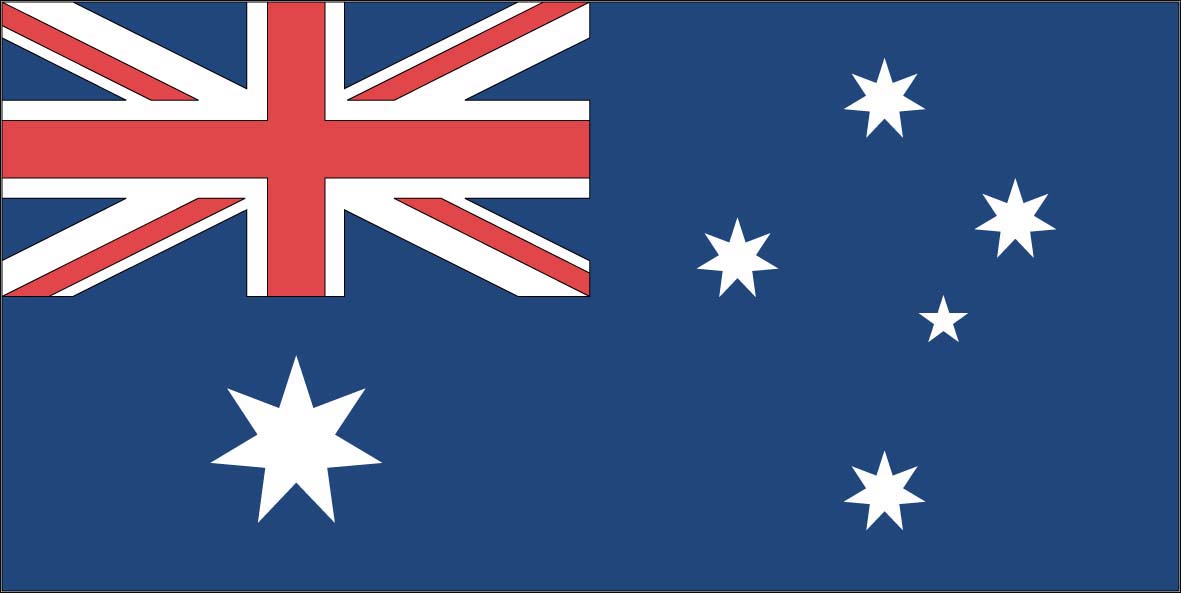
The Australian flag has a background of dark royal blue with the Union Jack in the canon (upper left corner of the flag).
There is a large white seven point star below the canon. This is the star of the federation. The right half of the flag depicts the Southern Cross, a constellation with one small five point star and four seven point stars that are equal in size and larger than the five point star.
The Union Jack represents the British colonization since Australia served as a penal colony.
The seven point star stands for the six Australian states and the seventh point symbolizes Australian territories. The Southern Cross is a constellation of stars that can be viewed in all of Australia’s states and territories.
The Australian flag was first used in 1901 after the country gained independence. For about fifty years there were two versions of the Australian flag.
The first had the same design but had a red background. On April 14, 1954 the blue ensign was adopted because many people felt that red symbolized communism.
Australia and Jordan are the only two countries in the world that use a seven point on their national flag.

There is a large white seven point star below the canon. This is the star of the federation. The right half of the flag depicts the Southern Cross, a constellation with one small five point star and four seven point stars that are equal in size and larger than the five point star.
The Union Jack represents the British colonization since Australia served as a penal colony.
The seven point star stands for the six Australian states and the seventh point symbolizes Australian territories. The Southern Cross is a constellation of stars that can be viewed in all of Australia’s states and territories.
The Australian flag was first used in 1901 after the country gained independence. For about fifty years there were two versions of the Australian flag.
The first had the same design but had a red background. On April 14, 1954 the blue ensign was adopted because many people felt that red symbolized communism.
Australia and Jordan are the only two countries in the world that use a seven point on their national flag.
Can be found at: http://www.world-free-printable-flags.com/meaning-of-australia-flag.html
Subscribe to:
Posts (Atom)